





Maintenance of Global Stability
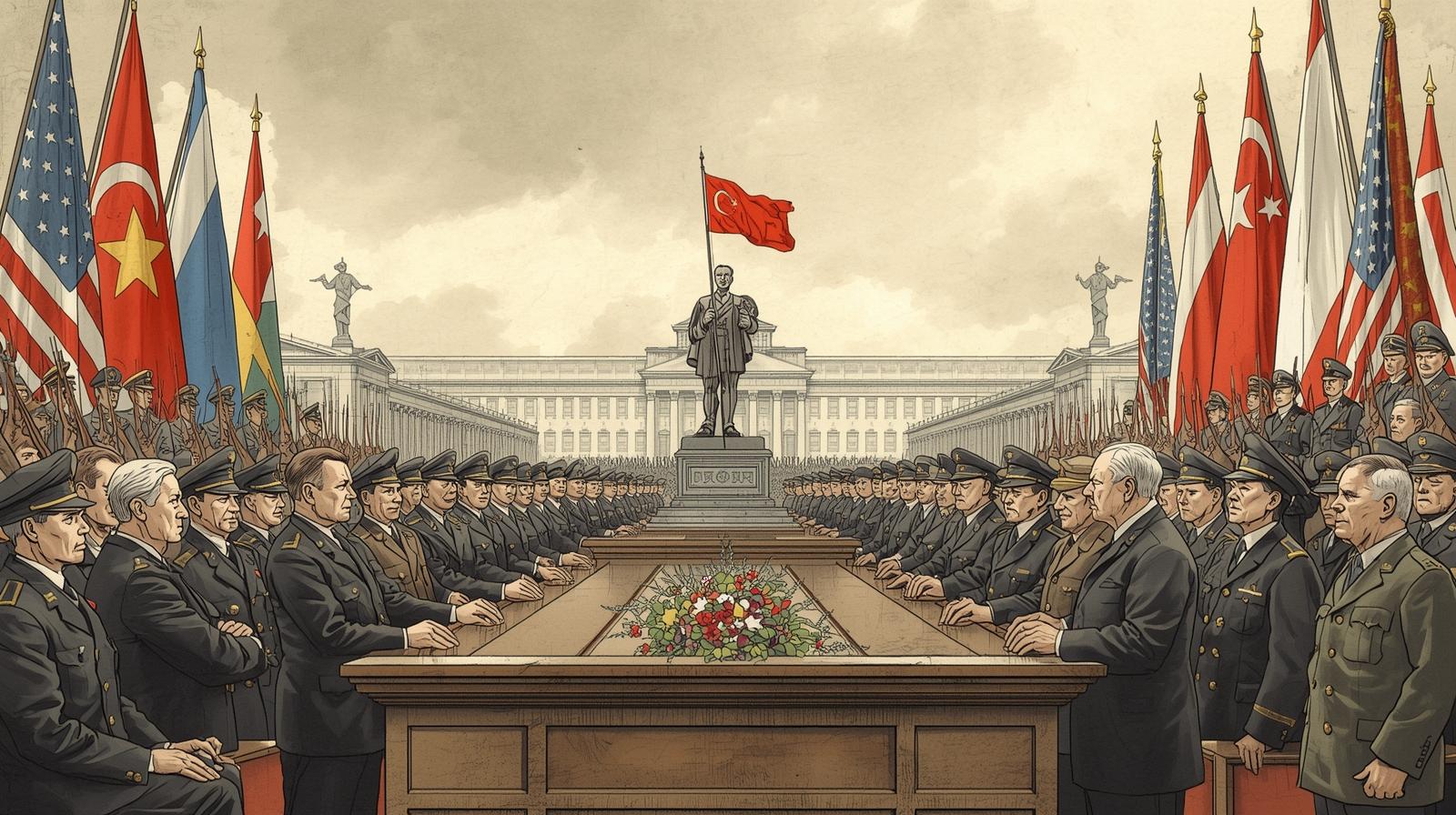

Compromises During the Early Stages of the Cold War 1947 – 1963: An Era of Equilibrium and Stalemate
Abstract
After qualitatively examining various events shaping the Cold Era, this paper argues that global stability was not only maintained through diplomatic efforts, but through a series of recognitions of boundaries amongst superpowers. This was demonstrated through mechanisms such as economic dependencies, nuclear diplomacy, and internal state control systems. Finally, the paper suggests that efforts to achieve stability were understood through complexities shaped by deadlock recognition, compromise, and restrictions.
Introduction
The early Cold War period (1940 – 1960) was about the persistent threat of global contestation between two superpowers from the West (the United States of America) and the East (the Soviet Union). Nevertheless, despite immense differences in ideologies and military competition, direct conflict was avoided. This era witnessed a succession of considerable crises, especially in Berlin and Cuba, in which the superpowers came precariously close to conflict due to the struggle for global dominance between the West and the Soviet Union. The argument of how stability was preserved despite this boiling point and the imminent threat posed by nuclear weapons remains fundamental to Cold War history. This article examines this period as a landscape of negotiated agreements, enduring stalemates where neither side could impose its will, yet recognized the catastrophic costs of escalation from both superpowers.
The paradox, which brought the world closer to a nuclear apocalypse, though persistently safe, requires thorough investigation. Traditional scholars have centered on the balance of power and military deterrence as an explanation for such compromises, but this still did not fully capture the complexity surrounding Cold War politics. Rather, what happened was a series of historical engagements of back-door diplomacy, which resulted in compromises and the acceptance of brinkmanship as a necessary evil to contend with global politics on the verge of human annihilation by nuclear weapons. This paper argues that the early Cold War stability efforts were not necessarily the result of military superiority of one superpower over another, but from a series of compromises and agreements negotiated mutually. This sets the framework for boundaries on economic ideologies and strife for internal political influence, as well as the terrifying shocks posed by nuclear weapons to mankind.
Case Studies in Stalemate: The Cuba and Berlin Crisis Security Deadlock
To illuminate the policies and significance of Cold War stability efforts, this paper centers on two pivotal periods that were most relevant to the crisis. The Cuban and Berlin crises brought the two most powerful states of the moment to the verge of open conflict. The division of Berlin between the USA and the USSR was among the arenas where differences or contestations in ideologies (capitalism and communism) were struggling for geopolitical influence in Europe. The Berlin Wall was a clear example of division among superpowers, where the struggle for influence almost brought chaos into the World. This division brought nothing to ordinary citizens other than pain and misery inflicted by superpowers and their desire to influence global politics, in which global security was at stake. Cuba, a small island in the Caribbean, witnessed an attempt by a nuclear power (the Soviet Union) to obliterate another, which was no other nation than the USA, competing to dominate global politics arising from ideological differences. States align themselves with those they think can assure their security, thereby posing security threats to others, risking global stability.
However, the outcome of both cases was not a decisive victory, but rather a series of negotiated agreements that resulted in some sort of compromise among superpowers such as the USSR and the USA to maintain stability. The dismantlement of nukes in the Caribbean and Turkey was a sign of logic and rationality, aiming to stabilize global politics in a very tense security environment. This was timely, and the outcome was averting a war, which ultimately happened. These scenarios created a possibility in which security issues could be discussed between the USSR and the USA, thereby reducing the chances of triggering conflict between them.
Theoretical Explanations
Deterrence Theory
The deterrence dogma is based on the premise that two superpowers have the same capability to inflict the same amount of damage on each other if attacked. As Plokhy demonstrated in his analysis of the Cuban Missile Crisis, a reciprocal fear of nuclear obliteration from both sides serves as a power dissuasion mechanism. The notion of mutually assured destruction (MAD) was not a mere abstract principle; it shaped the behavior of policy makers on both sides in terms of calculations, risk, and the damage that may be incurred if attacked. Deterrence, therefore, is not only based on military hardware but also on the psychological interpretations involved during the ongoing process, such as interpreting, signaling, and adjusting to the intentions of the enemy at stake.
Balance of Power Theory
Geopolitical contestation to influence world politics was framed between alliances such as the Warsaw Pact (WP) as well as the North Atlantic Treaty Organization (NATO). As Maier argues, the creation of NATO and the Warsaw Pact was mainly within the logic of the balance of power. It was necessary not to create a situation that might not be interpreted as a security dilemma, but rather as a balance of power. This was the case when the Soviet Union stationed nuclear weapons in Cuba against the US, and America retaliated by stationing nuclear weapons in Turkey as well against the Soviets. The alliances that were created during the Cold War Era institutionalized divisions, especially in Europe, and formulated rules of behavior that envisage predictability in a security tense environment.
Crisis Management
As Plokhy argued, the techniques of crisis resolution became increasingly complex as the Cold War progressed. The establishment of the Moscow–Washington hotline during the Cuban Missile Crisis perfectly served as a de-escalation mechanism through rapid and direct communication between the USA and USSR. Crisis management does not only involve diplomatic maneuvering, but also the establishment of arms control treaties, institutional policies (back door channels), and protocols for escalation that decrease the risk of unnecessary conflict. These policies were also an outcome of learning, prompted by innovations in the art of managing hostilities without allowing them to escalate into a full-blown war.
Internal Security and Domestic Control
Epstein recalls that stability was not merely an affair of external control, but rather the internal security network of superpowers and their puppet state playing a fundamental role in maintaining the status quo. In East Germany, for example, the Stasi repression and surveillance were vital in quelling unrest that might upset the global balance. Internal stability in this case was a necessary condition for external policies or compromises. Without conducive internal security, leaders could not legitimately negotiate efficiently abroad. A destabilized internal political environment could only project worse foreign policies – a scenario which the East German authorities were not ready to admit, considering the geopolitical influence and relevance of the internal politics on a global stage.
The Economic Dimension
Lorenzini and Maier both emphasize the importance of economic influence in shaping Cold War politics. Economic interdependence, which was vital for the development of Global South, shifted the burden on superpowers. These constraints did not eradicate rivalry, but they did shape the narratives for compromise and the desire to accept deadlock. The politics of trade, aid, and global institutions became a milieu for fierce competition, cooperation, and accommodation.
Maier places the Cold War within the context of postwar economic reconstruction, highlighting how both superpowers were invested in stabilizing Europe and avoiding another global depression. Economic necessity frequently triggered ideological confrontation, emboldening restraint and compromise. The Marshall Plan, for example, was not merely an instrument for economic recovery, but also a policy to stabilize Europe’s dilapidated economy, aimed at preventing any hardship that may trigger the kind of economic crisis as compared to 1930.
Implications
The Berlin Crisis as Managed Stalemate
The repeated crises over Berlin, culminating from the building of the Berlin Wall, illustrate that superpowers’ preference is maintaining the status quo over risking war. As Harrison explains, the Wall was a compromise that stabilized the situation despite its moral and political costs.
The Cuban Missile Crisis and Nuclear Compromise
Plokhy demonstrates that the Cuban Missile Crisis steered both sides to the verge of nuclear catastrophe, yet ultimately resulted in a negotiated settlement that ended up withdrawing U.S. missiles from Turkey and Soviet Union missiles from the Cuban Peninsula. This episode highlighted the utility of secret deals and the acceptance of partial victory in preserving peace. He describes the secret negotiations between John Kennedy and Soviet Ambassador Anatoly Dorbryin as a critical back channel that broke the brinkmanship.
Internal Security and Control
Epstein reveals the importance of internal security measures, such as the Stasi’s pervasive surveillance, in sustaining the domestic order required for Cold War stalemate. Stability was not just a matter of superpower diplomacy, but also of repression and control within divided societies. In the German Democratic Republic (GDR), the Stasi surveilled Eastern Germans to maintain control over internal politics, which also helped legitimize the GDR authorities’ abilities in negotiations abroad. This control mechanism actually helped to maintain stability both internally and externally.
Economic and Global Constraints
Lorenzini argued that economic interdependence and the politics of global development set limits on confrontation, encouraging both the US and the USSR to pursue stability through compromise and negotiation, both in Europe and the developing world. The Marshal aid significantly helped stabilize Western Europe and created a prosperous economy under the supervision of the Bretton Woods structures to champion the prosperity of nations. It was necessary to uphold a relatively calm and stable environment in order to maintain this economic stability, especially considering the suffering which incurred during the global wars in 1914 and 1939. As Lorenzini argues, the struggle for influence in the Global South most often obliged superpowers to pragmatic cooperation with local authorities.
The Red Line Communication Between Washington and Moscow
In order to reduce tension among themselves, the US and USSR established a direct, secure line of communication to prevent any accidental nuclear war that might occur as a result of miscalculation or miscommunication. It was necessary to prevent further recurrence, like the situation in October 1962, by designing a red line of communication. The hotline was a fruitful result of the crisis, stemming from the realization that delays in communication could be costly. This red line of communication drastically shaped the behavior of the USSR and the USA by dealing with issues that might provoke any global war.
Military Alliances
Due to geopolitical battles between the USSR and the USA, military alliances were created not only to protect their interests. They also wanted to maintain an effective balance of power that might result in a security dilemma situation, thus upholding a relatively controlled security environment between these two superstates. NATO, created in 1949, and the Warsaw Pact, created in 1955, established military alliances that played a fundamental role in stabilizing the bipolar world. Military alliances were a fundamental architecture in maintaining stability during the Cold War. Military alliances serve as a balance of power mechanism. Alliances created an institutionalized, bipolar order based on division that is capable of predicting the sphere of influence and the likelihood of miscalculation. They acted as checks and balances, ensuring the other side, considered an adversary, does not come to enough power to overtake the other, thereby keeping the security situation tense but under control.
Arms Control Mechanisms – LTBT of 1963
The Test Ban Treaty (TBT) in 1963 outlawed nuclear tests in the air as well as space, which contributed to the maintenance of stability during the Cold War Era. Political will was needed to enforce this mechanism. Although not fully implemented, it helped regulate the behavior of the two most powerful states on the planet, which also reduced the arms race and radioactive contamination. The limited test ban was a direct pragmatic outcome of the Cuban Missile Crisis Khruschev saw this as a crucial sign towards peaceful coexistence, a view cautiously shared by Kennedy. The arms control framework (LTBT) between the UK, USSR, and USA prohibited nuclear tests in the atmosphere and outer space, reflecting a shared desire that superpowers were ready to reduce the risk associated with nuclear weapons and environmental harm.
Security Dilemma and Stability
The existence of opposing military alliances introduced a classical security doctrine called “security dilemma”. This means a military enhancement from one side was considered a threat to the other side and automatically necessitated rearming in order to be at the same level, triggering an arms race and crisis. Yet, these military alliances overcame these obstacles by including or organizing joint military planning, shared intelligence, and diplomatic channels that were able to quell any potential threat to stability and peace. These military blocs contributed to stability by signaling the consequences of aggression and bolstering cooperation among allies. They were not simply tools for hostilities, but a framework in which rivalry was contained.
Recommendations
- Acknowledge the Utility of Deadlock: Policymakers and scholars should acknowledge that stability can emanate from the acquiescence of limits and the readiness to compromise, even in the absence of conclusive settlements.
- Crisis Management Policies: The initiation of a direct communication line, such as the hotline after the Cuban Missile Crisis, is vital for overseeing miscalculation and escalation during a crisis.
- Equilibrating Internal and External Security Mechanisms: Effective management of superpowers’ rivalry warrants the awareness of both internal dynamics and global diplomatic efforts to overcome regime stability
- Incorporate Economic and Developmental Measures: Understanding the function of global economic institutions and foreign aid is essential for understanding the full context of Cold War stability mechanisms.
Conclusion
Global stability in the early Cold War developed from a series of precarious compromises and enduring deadlocks. The Cuban and Berlin Crises were not resolved through victory or capitulation, but through negotiated agreements that sustained peace at the cost of division and persistent rivalry between two superpowers – the USA & USSR. The evolution of economic factors, internal security, and international politics all contributed to an unpredictable environment where conclusive action was constantly less valued than cautious restraint. The repercussion of early Cold War stability efforts is an experiment in the management of crisis: That peace was achieved through flawed agreements. However, this was accomplished through recognition of boundaries and the desire to renegotiate existing security agreements, even under the existential threats posed by both sides. Nevertheless, the 2022 invasion of Ukraine by Russia still shows some signs of failed compromises that continue to culminate in the existing Russo–American relations back in the days of the Cold War.


