Irregular Warfare in the Asia-Indo-Pacific and Against the Dark Quad / CRInK

Setting the Geo-Strategic Frame
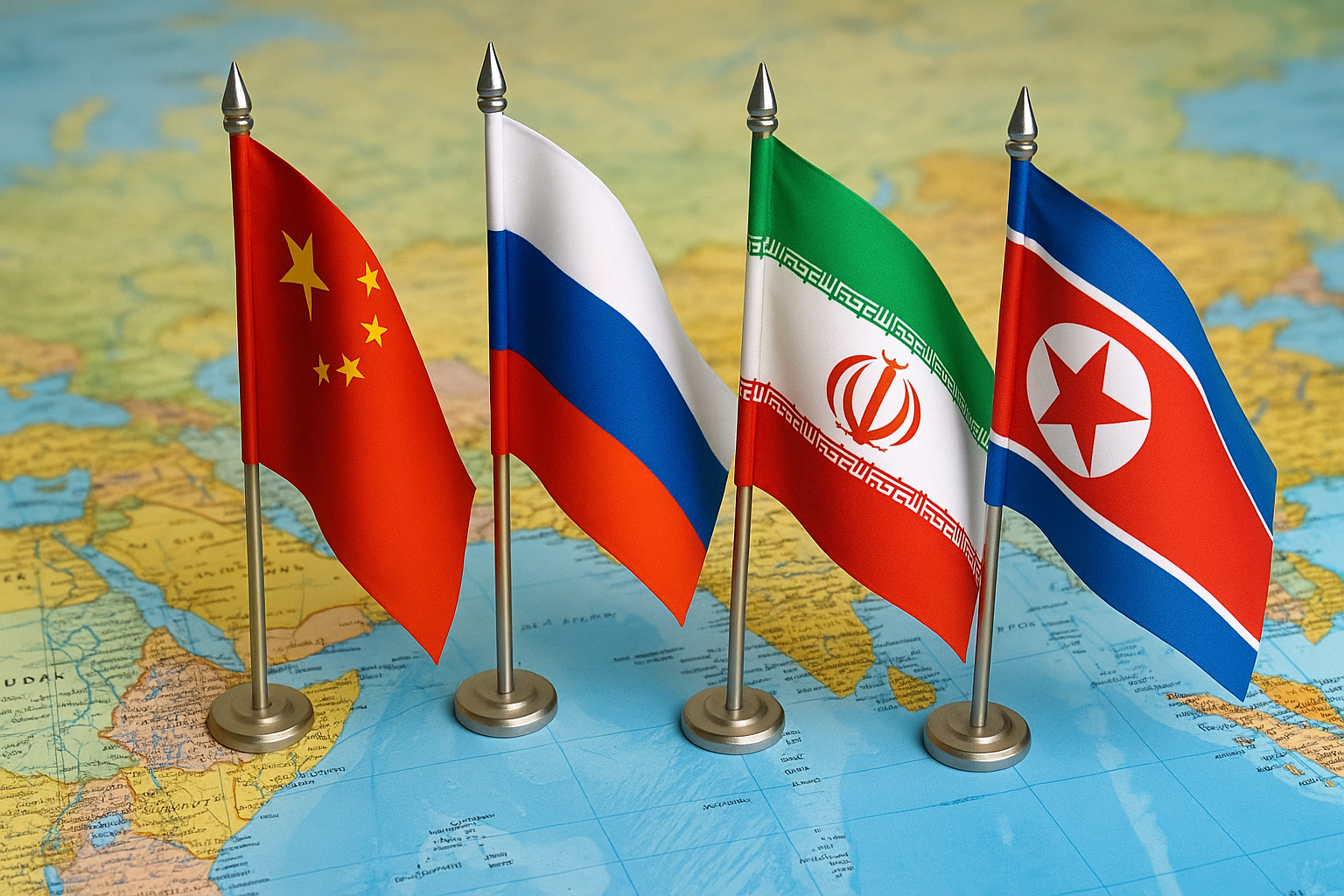
The world is sliding into a long political war. It moves without ceremony across the seas and archipelagos of the Asia-Indo-Pacific. Its front lines run through villages, ports, digital networks, and the minds of men and women who live under pressure from four authoritarian powers that now operate with shared purpose. China, Russia, Iran, and north Korea have fused their ambitions into an informal alignment that has become known as the Dark Quad or CRInK. Their collaboration links the Eurasian landmass and the Asia-Indo-Pacific into one contested system. They do not see separate theaters. They see one struggle, connected across geography and ideology.
In this contest the most likely form of conflict is not a clash of fleets or armies. It is the steady application of political warfare and irregular pressure that operates below the threshold of open war. The terrain that matters most in this environment is human. Power flows from legitimacy, from the strength of alliances, and from the stories that shape the choices of partners and populations. Guns and ships hold their value when shots are fired. Until then the contest is fought in the minds of people who decide whether they will bend to authoritarian pressure or stand with free nations.
We must understand this simple truth. Our adversaries are already waging war. They accept Mao’s maxim that politics is war without bloodshed. They see conflict as permanent. We still behave as if peace is the default condition and war begins only when the shooting starts. That old habit belongs to another age. The Dark Quad has no intention of giving us the luxury of waiting for a crisis before we act.
Why Irregular Warfare and Political Warfare Matter
Irregular warfare is the military arm of political warfare. Political warfare is the whole of government approach to strategic competition in the gray zone that stretches between peace and war. Our joint doctrine defines irregular warfare as campaigns that assure or coerce through indirect and asymmetric means. Congress has added clarity by describing irregular warfare as activity conducted by, with, and through regular and irregular forces, groups, and individuals in competition short of traditional armed conflict to achieve national policy objectives.
This means irregular warfare demands campaign plans. It cannot be a collection of scattered actions. It must be continuous. It must have a theory of victory. It must align the instruments of power behind a shared purpose.
Our adversaries practice political warfare every day. China wields its unrestricted warfare and three warfares doctrine with discipline. Russia conducts new generation warfare that blends intelligence, cyber, information, and paramilitary tools. Iran spreads influence through its light footprint proxy model. North Korea uses political warfare and blackmail diplomacy as its main effort. They understand the power of narrative. They understand the leverage created by corruption, disinformation, coercive trade, and covert action. Each of them practices irregular and political warfare against us and our allies in the Asia-Indo-Pacific.
If we fail to match them in this environment, we will lose ground even if our ships grow larger and our missiles fly farther.
A Modern NSDD 32 for the Asia-Indo-Pacific
During the Cold War President Reagan issued his national security strategy in National Security Decision Directive 32. It was a top secret document with only 36 copies. It provided a coherent political warfare strategy that integrated economic pressure, information operations, diplomacy, and covert action to weaken Soviet power. It aligned the interagency behind a simple idea. The United States would compete in every arena and would roll back Soviet influence where possible.
We need the same logic today. A modern directive focused on irregular and political warfare for the Asia-Indo-Pacific would give strategic coherence to this contest with the Dark Quad. It would define irregular and political warfare as core missions, not niche activities. It would direct an interagency political warfare campaign that begins in the Asia-Indo-Pacific because that is where the pace of strategic competition is fastest and the stakes greatest. It would place priority on supporting allies who face daily coercion from China, north Korea, and Russian influence networks. It would establish clear authorities, responsibilities, and measures of effectiveness for sustained gray zone campaigning.
Such a directive must recognize a hard truth. The security problems of the Korean Peninsula and Taiwan Strait are linked. What happens in one will affect the other. Treating them as separate planning problems is a path to failure. A modern NSDD must integrate these challenges into one strategy that sees the region as a single connected struggle.
The DISRUPT Act as Foundation
Congress has already taken a decisive step. The draft bipartisan DISRUPT Act directs the Departments of State, Defense, Treasury, Commerce, CIA, and the DNI to craft a whole of government strategy to disrupt and constrain CRInK cooperation. The Act recognizes that a crisis involving any one of these four adversaries can quickly become a multi theater problem. It understands that our current command structures and planning tools are not designed for a simultaneous challenge from four aligned authoritarian powers.
The DISRUPT act provides the legislative foundation for a political warfare strategy. It calls for intelligence integration, technology controls, sanctions, and coordinated planning across agencies. But legislation alone cannot create a campaign. To operationalize DISRUPT in the Asia-Indo-Pacific we need a new organization built for political warfare. We need a Political Warfare Service 2.0. Or it could be an Office of Strategic Disruption. Regardless of the name it should be an OSS for the digital age, a civilian led agency with military support. It would fuse intelligence, influence, cyber, economic warfare, resistance support, and covert action into coherent campaigns. It would become the action arm for a modern NSDD on irregular and political warfare.
This new service should be charged with leading DISRUPT implementation against CRInK in the Asia-Indo-Pacific. The region is where the Dark Quad is already shaping conditions for advantage. If we wait for crisis, we will find ourselves reacting to a script written by Beijing, Moscow, Tehran, and Pyongyang.
Kennan and the Gray Zone Mindset
George Kennan gave us the clearest definition of political warfare. It is the employment of all the means at a nation’s command short of war to achieve national objectives. Paul Smith refined the idea by emphasizing intent and the use of political means to compel an opponent. These concepts remain vital today.
Our adversaries have adopted and adapted his logic. China conducts lawfare, psychological warfare, and public opinion warfare as part of its three warfares doctrine. Russia uses covert action, information operations, and private military companies to shape events without triggering open war. Iran uses proxies and covert networks to expand influence. north Korea blends information operations, subversion, cyber theft, and nuclear blackmail to preserve regime survival.
We must regain the mindset that Kennan described. Influence is often stronger than firepower when firepower cannot be used. Legitimacy can defeat coercion. The will of free people who trust their institutions can withstand subversion. But these outcomes require deliberate action.
Irregular Warfare in the Asia-Indo-Pacific
The Asia-Indo-Pacific is the decisive theater for irregular warfare. It is where the authoritarian powers apply their pressure most aggressively. It is where American allies live under daily coercion. It is where the future of the international system will be shaped.
Irregular warfare gives us tools that fit this place and time. We can help partners build resilience against political subversion. We can expose corruption, disinformation, and malign influence. We can support democratic movements inside authoritarian regimes when aligned with policy. We can build denial networks that complicate Chinese coercion and expansion. We can strengthen resistance capabilities in vulnerable states. We can contest the information environment where authoritarian narratives seek to cast doubt on the value of freedom.
USSOCOM’s enduring missions in the region already lean toward this work. Special Operations Forces build relationships and knowledge that become the foundation for influence, deterrence, and preparation of the environment. These missions strengthen allied networks and create the irregular deterrence that complicates adversary plans.
The Korean Peninsula is a proving ground. A future collapse or internal crisis in north Korea will produce major irregular threats: Insurgent remnants. Criminal networks. Humanitarian breakdown. Foreign intervention. If we do not plan for irregular warfare in Korea now we will be overwhelmed later. Our alliance must develop irregular warfare campaign plans that aim toward a clear end state. That end state should be a free and unified Korea that is stable, non-nuclear, and anchored in liberal constitutional governance.
The Mindset Shift
Our greatest obstacle is not lack of capability. It is lack of mindset. We suffer from definition paralysis. We create new terms rather than act. We should stop debating labels and accept that irregular warfare is the military face of political warfare.
Irregular warfare forces us to think about people first. It demands we understand the psychological, cultural, and historical foundations of conflict. It reminds us that legitimacy is more powerful than fear. It teaches us that resistance has value and that free people can be our greatest allies.
This requires national level leadership. Questions that hang over Washington are simple. In this new political war who will play the role of JFK? Who will elevate irregular and political warfare to the center of national strategy? Who will put the nation on a footing that matches the resolve of the Dark Quad?
Conclusion
We cannot deter the CRInK with conventional and nuclear forces alone. The Asia-Indo-Pacific is a theater shaped by influence, narrative, legitimacy, and the resolve of a silk web of allies who stand on the front lines. If we fail to compete in the gray zone we will discover that deterrence erodes even when our arsenals grow.
A modern NSDD for irregular and political warfare, grounded in Kennan’s logic and built upon the DISRUPT Act, would give the United States the strategic coherence it needs. It would direct a sustained campaign in the Asia-Indo-Pacific that treats political warfare as the main effort. It would create the unity of purpose required to confront an alignment of authoritarian powers that seek to reshape the world.
We face a clear choice. Either we organize, resource, and conduct political and irregular warfare on our own terms, or we allow the Dark Quad to dictate the pace and terms of competition. The stakes are nothing less than the future of the Asia-Indo-Pacific and the character of the international order that will shape the next century.
If we choose to act, we can seize the initiative. If we fail to act, we will drift into a world shaped by those who understand political warfare better than we do.
Please check out everything Small Wars Journal has to offer.