





Mission Implausible: Revisiting the False Flag Narrative of Turkey’s July 15 Coup

A recent essay challenges the official interpretation of Turkey’s July 2016 coup attempt. The authors argue that the episode was not a genuine military uprising but was a false flag operation designed to consolidate President Erdoğan’s power. Their case is built on a range of purported irregularities in the coup—ranging from Turkey not fitting the normal pre-coup profile to the absence of a detailed operational plan, seemingly self-defeating behavior of participants, and the immediate launch of massive purges afterward. These anomalies are said to point not to incompetence or disorganization, but to deliberate orchestration by the state.
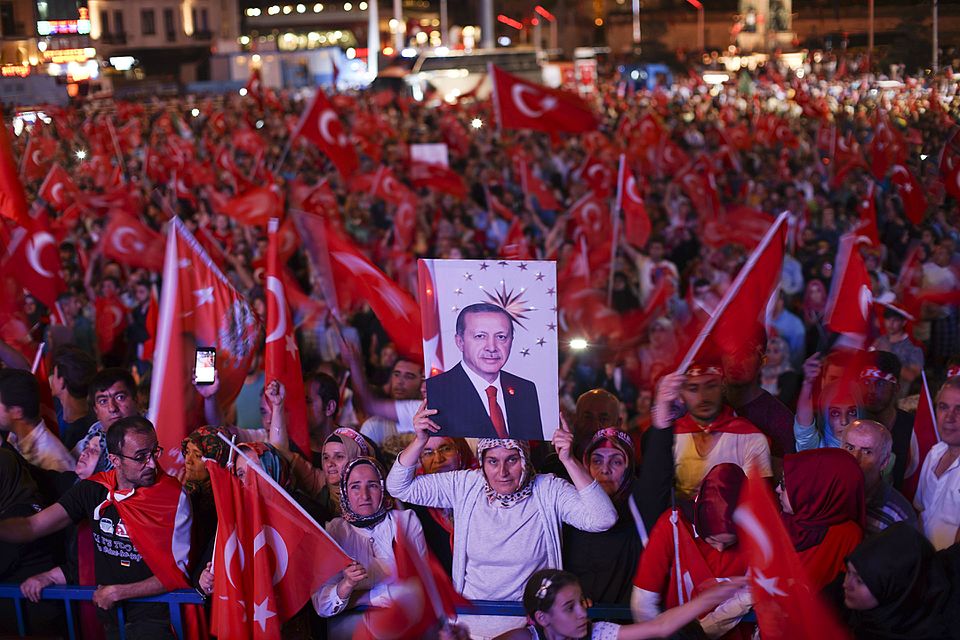
While this essay focuses on the interpretation of evidence rather than the full chronology of events, some brief context is in order. On July 15, 2016, factions within the Turkish military attempted to seize power, mobilizing tanks and troops in major cities like Istanbul and Ankara. The coup quickly faltered in the face of organized resistance by loyalist forces and widespread civilian opposition. Hundreds were killed or injured, thousands were detained, and in the aftermath, President Erdoğan oversaw a sweeping consolidation of power, including mass purges of military personnel, civil servants, and judges.
As scholars of military coups who have investigated over 500 coup events, we are very familiar with both the general tendencies of coups, the occasional oddity, and the frequent need to challenge official narratives. Though the revisionist perspective in “Rethinking the Narrative” invites valuable skepticism toward the official account, the argument relies on a variety of false assumptions about coups, omits key counterpoints, and requires a number of leaps in logic. As a result, the essay’s conclusions risks misrepresenting not only the nature of the July 15 events but also broader dynamics that are common in military coups.
The Pre-Coup Profile
The authors point to a number of ways in which Turkey did not align with the factors we would typically associate with a coup attempt. The authors cite Powell’s previous observation that the Turkish case was unusual when considering dynamics such as the size of the military and economy. To be clear, Powell nor his coauthor in that earlier work questioned whether this was a bona fide coup attempt.
The authors contend that “several facts contradict the traditional markers of an imminent coup,” pointing to the lack of “severe economic turmoil” or recent “civil-military crises.” Though this might be true, such dynamics are not necessary conditions for coups. In fact, the very research the authors invoke is generally probabilistic by design – these factors raise or lower coup risk; they do not dictate outcomes. More importantly, the picture does not look as puzzling when considering a broader range of coup determinants. For example, Andy Beger and Mike Ward’s coup forecasts had Turkey ranked as the 11th most likely country to experience a failed coup going into 2016. In other words, Turkey’s pre-coup profile looked far more like a coup candidate than “Rethinking the Narrative” acknowledges.
False Dichotomy
The authors effectively argue that the July 15 events were either a genuine coup or a pretext for Erdoğan to consolidate power. This framing overlooks a well-documented tendency for both to be true; that is, for leaders to exploit failed coups for political gain. In some cases, leaders may deliberately all a plot to move forward due to the benefits of catching conspirators in the act.
There are obviously cases in which failed coups are not followed by mass retaliation, such as the Spain and Venezuela cases used by the authors, but post-coup repression is very common. Writing in African Affairs, Powell and a few colleagues previously argued that already-autocratizing leaders will use failed coups to justify actions that further strengthens them. Indeed, they specifically reference Erdoğan’s acknowledgment that the coup could serve as a gift from God. Various studies have demonstrated this works through multiple pathways, including political purges, state-sanctioned violence, reduction in civil liberties, personalization of power, politicizing appointments, and other acts. Though larger in scale than other cases, one could argue that Turkey’s post-coup developments were precisely what would have been anticipated.
Absence of Evidence as Proof
The authors repeatedly use argument from silence logic in which an absence of evidence is actually presented as evidence. Perhaps most interesting is the interpretation of the lack of a written coup plan. Many – including us – would be unsurprised to learn that a criminal conspiracy was not carefully documented. To the authors, the lack of evidentiary documentation demonstrates that the event could not have been genuine, as if all coup conspiracies leave behind a written record of the plot.
There are, of course, numerous conspiracies in which plotters do not generate such documentation. Edward Luttwak’s classic book Coup d’etat: A Practical Handbook instructs conspirators in the maintenance of operation security. First in Luttwak’s guidance is that “no information [is] to be communicated except verbally.” While there are plenty of examples of written documentation and some written records might be unavailable, such as drafts of public announcements, it is obvious that such records will be avoided.
And if such documentation is so necessary for genuine coup plots, it is unclear why a government ostensibly willing to kill its citizens in a false flag operation would prove unwilling to fabricate such evidence. Indeed, Turkey itself might be no stranger to such fabrications.
Historical Analogues
The analysis engages in frustratingly selective use of case evidence. The authors highlight inconsistencies when compared to other cases—such as unusual troop behavior, forensic irregularities, and the timing of government responses. Overall, the coup “made no strategic sense” to the authors.
The authors effectively assume coups are both invariably well-planned and executed according to that plan. Yet many historical coups also featured tactical confusion and internal miscommunication. For instance, In Venezuela’s 2002 coup, conspirators somehow failed to disarm the National Guard after briefly toppling Hugo Chavez. In Libya in 1969, Muammar Gaddafi and his fellow conspirators became lost en route to seize power from King Idriss Snoussi. Kenya’s 1982 coup was notoriously labeled as “amateurish”, flopping due to a “comedy of errors.” Blunders are common in coup attempts, and have even been invoked to explain why some coups turn bloody.
In emphasizing only corroborating evidence, the authors fail to recognize that the cases they reference in support of their claims in one context, in fact, contradict those claims in others.. The 1992 attempt in Venezuela and 1981 attempt in Spain are used to illustrate a lack of a post-coup crackdown. But these cases also demonstrate the lack of coherent execution or tactical blunders the authors take to suggest a false flag in the Turkish case.
The historical false flag examples are also poor models for the Turkish case since a bombing and arson attack do not require large numbers of people to be caught in the act. A Turkish false flag does, and successfully executing such a conspiracy would have required the willing participation of scores of Turkish soldiers willing to face life imprisonment or being killed during the maneuver. The level of coordination such a deception would require renders the false flag thesis far less convincing than a far simpler explanation—that elements within the military attempted, and failed, to seize power.
A Third Option
The authors ultimately present the reader with two options: the “Turkish government’s narrative” and a false flag operation. A third option is agreeing with the claim that July 15, 2016 was indeed a coup attempt, but disagreeing with many of the government’s claims about the event. This includes the number of deaths, how those deaths occurred, the complicity of the many thousands arrested or purged, and the accusations against specific individuals such as Fethullah Gülen.
To the authors, a failed coup must meet an almost exhaustive list of conditions. It must be preceded by economic turmoil and civil-military friction, involve extensive collaboration among conspirators, and include a written operational plan. The plot must unfold according to that plan, feature willing and forthcoming witnesses, be accurately reported by the government, and be followed by restraint in the aftermath.
By such criteria, few coups in modern history would ever meet these standards. This underscores how the framework sets an unrealistically high bar and risks misrepresenting the realities of how coups actually unfold.



