





Guerrillas and Governance: Lessons on Resistance Forces and The Local Populace from The American Civil War

Abstract
Guerrillas and other irregular forces in the American Civil War actively engaged with the civil populace on a day-to-day basis and often relied on it for their very survival. Modern Special Operations Forces (SOF) can learn a great deal about guerrilla units and how they leverage the civil domain by studying two famous units: “Mosby’s Rangers” and the “Knight Company.” More importantly, the modern practitioner may find their aperture widened by engaging with the history of the American Civil War “off the beaten path” of famous battles like Antietam and Gettysburg.
Why Study the Civil War?
The American Civil War provides a wealth of case studies useful to contemporary Special Operations Forces (SOF). There is perhaps no other topic in American history with more scholarship devoted to it; primary source documents are plentiful and in English, and battlefields and historic sites are easily accessible in the United States. Unfortunately, the Civil War is often ignored by SOF practitioners. Perhaps this is because most people still view the conflict as a largely conventional one, with uniformed armies facing off in large set-piece battles. While this was indeed the case in many theatres, and battles like Gettysburg and Shiloh were easier to understand and even romanticize after the war, Irregular Warfare was also pervasive throughout the American Civil War and merits study by modern professionals.
From more well-known cavalry raids, to sabotage operations, to savage wars of murder and retribution between Appalachian and Missouri families and neighbors, examples abound of actions of interest to modern Special Forces, Civil Affairs, and Psychological Operations personnel, as well as other SOF practitioners. Confederate forces launched a commando raid into New England from Canada while Union amphibious elements waged a campaign of economic destruction on the rivers of the Deep South. Confederate propagandists attempted to sway the opinions of European powers and push the governments of Britain and France to intervene. Guerrillas raided, spies collected intelligence, and both sides vied for influence over the population. North and South both recognized early on the need to secure and gain the support of the civilian population in contested areas. President Lincoln advocated for operations into eastern Tennessee to support Unionist civilians there, and Confederate irregular forces attempted to stoke secessionism in Missouri and Maryland while isolating Unionist enclaves in West Virginia. Support for civilian populations was a key consideration in both large conventional campaigns and small irregular actions.
Modern SOF professionals may be called in the future to recruit and train resistance forces while conducting shadow governance against an occupier in Unconventional Warfare. Furthermore, modern SOF may be tasked with undertaking these actions in support of adjacent Large Scale Combat Operations (LSCO), much as guerrilla forces did from 1861 to 1865.
Rather than attempt to distill four years of Irregular Warfare into a few pages, this article will briefly discuss two case studies that highlight aspects of Civil-Military Operations conducted by guerrilla forces during the war. Modern SOF professionals may be called in the future to recruit and train resistance forces while conducting shadow governance against an occupier in Unconventional Warfare. Furthermore, modern SOF may be tasked with undertaking these actions in support of adjacent Large Scale Combat Operations (LSCO), much as guerrilla forces did from 1861 to 1865. These examples of historic operations will make the case that a renewed study of the American Civil War is highly beneficial for contemporary SOF.
This article will briefly explore Civil Military Operations and broader relations with civilian communities undertaken by two irregular forces: The 43rd Virginia Cavalry Battalion (known as Mosby’s Rangers), a uniformed Confederate partisan cavalry force in northern Virginia, and the Newton Knight Company, a loosely organized Unionist resistance in northern Mississippi. Mosby’s Rangers and Newton Knight’s Company didn’t simply conduct ambushes and sabotage. They were intrinsically linked with the local populace. Despite being different forces in extremely different places and circumstances, both guerrilla units relied on the local populace for intelligence, logistics, and communications. Moreover, their resistance forces were in fact a challenge to the occupying authority’s governance itself. Viewed through different lenses, both forces can be framed as resistance movements: Mosby’s Rangers as a resistance to Union occupation, and Knight’s Company as a resistance to an illegitimate Confederate authority and occupation. Both abound with lessons for the modern SOF professional.
“Mosby’s Confederacy”
“Resistance can consolidate gains in public support and initial governance capacity by utilizing Civil Affairs assessments, strengthening civil vulnerabilities, and cementing a bond with the greater population… Methods to realign the legitimacy of power should consider the timeliness required to restore essential services and strengthen the bonds between the population and the resistance movement…” – FM 3-57 Civil Affairs Operations
From the beginning, the 43rd Virginia Cavalry Battalion, which would come to be known as “Mosby’s Rangers,” had, in part, a population-centric mission. General Robert E. Lee’s vaunted cavalry commander, Lieutenant General “Jeb” Stuart, stated that his reason for sending Mosby and his men to the region was “to look after the loyal Confederate people.” Then-Captain John S. Mosby was a gifted amateur, a young lawyer before the war with no military experience. He carved out a piece of territory behind Union lines in the Fauquier and Loudon counties of Virginia that became known as “Mosby’s Confederacy.” Mosby and his men even managed to keep a good portion of this territory free of Union control until the end of the war.
Mosby didn’t merely raid Union outposts, railroads, and wagon trains; he attempted to extend Confederate government presence where it had been absent and kept the movement alive in a key middle-class community that had ardently supported Virginia’s secession, years after conventional Confederate forces had lost control of the northern reaches of Virginia. In the absence of a civilian Confederate government, the young lawyer-turned-cavalry officer became a quasi-official. He enforced draft laws and acted as a shadow judiciary on behalf of the Southern authorities. Mosby’s governance attempted to maintain law and order among local citizens, and by billeting his men in local homes and buying supplies from local merchants, he injected much-needed cash into the economy. The Rangers’ expulsion of Union cavalry from the area enabled a robust black market and smuggling network that took advantage of the porous border with Maryland and the Southern sympathizers there; Union-made goods and Union currency flowed freely into “Mosby’s Confederacy.” Thus, the young cavalry leader established a sense of legitimacy through both enforcement and economic opportunity.
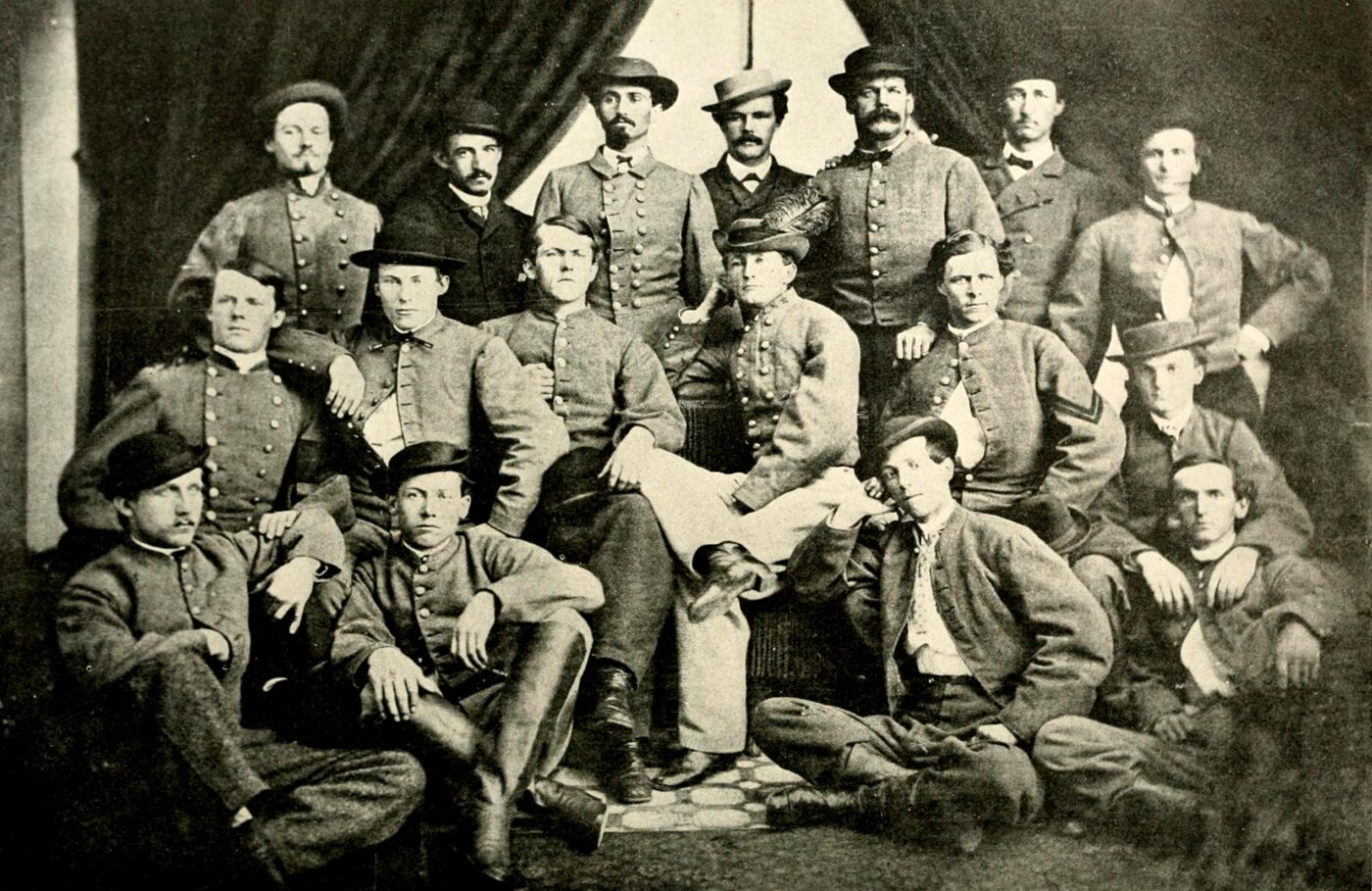
Mosby’s Rangers (John Mosby, 2nd Row, Center)
Because Mosby and his Rangers relied on locals to house and feed them, they were known for maintaining good order and discipline when most other partisan bands were notorious for being little more than roving thieves who preyed on civilians indiscriminately. Mosby went further than other Confederate partisans and protected Unionist civilians in his area of operations as well. He maintained discipline and respect for civilian property in part because he refused to allow deserters from other Confederate units to join his ranks. Deserters were often drawn to the spoils that partisans were permitted to keep or sell, but Mosby was uncompromising in keeping them out of his Rangers. It should be noted that the 43rd Virginia Cavalry Battalion wreaked utter havoc on civilian infrastructure deemed (by them, at least) to be a part of the Union war effort, namely railroads, telegraph lines, and wagon trains. Nor was plundering completely off the table, as illustrated by the robbing of civilians during the “greenback raid.” Nevertheless, Mosby’s reputation, and thus the legitimacy of his actions, remained generally positive among local civilians.
Civilians in Mosby’s Confederacy provided a network of intelligence as well as an early-warning system in the event of Union cavalry raids. They also spread news of the Partisan Rangers’ exploits to bolster pro-Confederate feelings and disinformation to deceive Union troops. The civilian intelligence network aided Mosby in his reconnaissance (often undertaken personally before a raid) to find vulnerabilities in Union trains and blockhouses. Frustrated, Federal troops often responded by destroying civilian property in retaliation for the raids of the 43rd Virginia Cavalry Battalion, which only enhanced the narrative of Mosby’s representation of the only legitimate governing authority for the locals. Perhaps a key Measure of Effectiveness for Mosby’s methods is their emulation by his most successful adversary. Captain Richard Blazer’s Independent Scouts [Union] were lenient with local civilians and prisoners to build intelligence networks of their own and hound Mosby’s Rangers.
In his book The Uncivil War: Irregular Warfare in the Upper South, 1861-1865, Robert R. Mackey makes the distinction that while Mosby was often called a guerrilla, he is more accurately described as a partisan and fits a specific mold of 19th century warfare. Because Mosby and his forces accorded themselves with this distinction, they were more palatable to their own government, their enemies, and indeed, the civil populace upon which they relied. The 43rd Virginia Cavalry Battalion and their gifted commander were uniformed partisans, not locally recruited resistors (at least, not initially). Nonetheless, they cultivated important relationships and provided governance and the rule of law in an occupied area. They enabled a wartime local economy to expand, and in return, they were provided with shelter, recruits, and intelligence.
While not exhaustive, nor necessarily universal laws by any means, the following lessons from Mosby’s Rangers should stand out to the modern SOF reader:
- The resistance need not be organic: A resistance force (or the nucleus of one) can be inserted behind enemy lines if a sympathetic civilian population and the right terrain both exist.
- Guerrillas can govern: Resistance fighters may be called to extend governance into a previously denied area.
- Hearts and minds are still important: Respect for property and the rule of law can maintain popular support and keep intelligence and logistics networks robust.
- Common cause isn’t enough: buying supplies locally and enabling smuggling networks or black markets may be necessary to keep up the support of local civilians.
- Think strategically: Mosby understood the context for guerrilla operations beyond a mere tactical action; he recognized that resistance forces could draw enemy strength away from the main, conventional battlefields, much as modern resistors could in LSCO.
“The Free State of Jones”
“Civil Affairs forces are typically sought for their unique capabilities with regards to identifying and mitigating the underlying causes of instability in order to create a stable environment. This same analysis, however, can be utilized by the resistance to identify and degrade those identified strengths and bonds of the existing regime into vulnerabilities, resulting in its continued delegitimization. This creates legitimacy opportunities for the movement.” – FM 3-57 Civil Affairs Operations
The yeoman farmers and cattle herders of Jones County, Mississippi, had little use for secession. The county was not a large slave-holding area, and the poor and middle-class people felt that the conflict was a “rich man’s war.” Newton Knight was one such yeoman farmer. He enlisted in the Confederate Army with friends and relatives to avoid being drafted but soon abandoned the war and returned to his home. Knight and other Confederate soldiers were often driven to leave their units in large part because of the plight of their families; their wives, children, and relatives were abused by oppressive Confederate tax collectors, who robbed them of the food, clothing, and other supplies that they needed to survive. After the Confederate defeat at Vicksburg, even more Jones County soldiers deserted and made their way home.
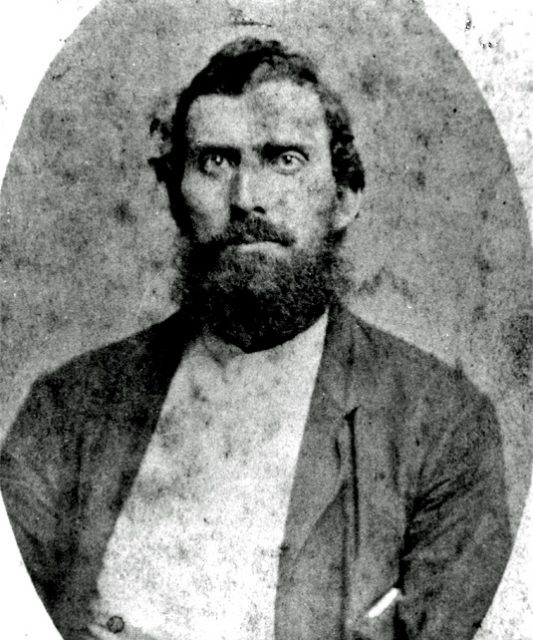
Newton Knight (1829-1922), an Anti-Confederate Guerrilla from Mississippi.
Knight organized these deserters from Jones County and surrounding areas into an ad hoc unit called the “Knight Company” to protect themselves and their families from Confederate taxation and draft enforcement. Knight’s unit also included escaped slaves. Members of the company utilized swamps and other restrictive terrain to conceal themselves, and relied on a network of sympathizers for provisions, intelligence, and communication (often using cattle horns to send signals). By spring of 1864, the Jones County rebels had effectively pushed out Confederate authority in the region, and news that the county had “seceded” from the Confederacy reached both Northern and Southern leaders. To meet this challenge, a substantial force of Confederate troops was sent in to restore control of the population centers, arrest or hang deserters, and drive Knight and his men back into the swamps. The outside forces that entered Jones County were quickly confronted with the reality that spurred the Knight Company to resist.
One Confederate officer who was a part of the force that reestablished control of Jones County wrote to the governor of Mississippi and provided a remarkably astute assessment of the civil vulnerabilities and grievances among the local populace that led to the all-out revolt of the Knight Company and the citizens of the area as a whole:
Provisions are now scarce particularly corn… If something could be done to ameliorate their condition by State authorities it would be productive of a much proved moral and political sentiment. It would [convince] them that we have a government, a fact which they are inclined to doubt.
Indeed, the impending starvation of their families was one of the factors that drove Knight and his neighbors to desert in the first place. This lack of essential human needs created a governance vacuum that Knight and his resistance fighters attempted to briefly fill in the “Free State of Jones.”
The same officer also identified that thieving and abusive behavior by Confederate tax collectors and draft enforcers had inflamed the situation and stoked the grass-roots resistance movement: “In several circumstances improper [shirking], robbing, stealing [which] the houses, cutting the cloth from looms, taking horses [etc.]. These acts have done more to demoralize Jones County than the whole Yankee army.” He also recognized that the Knight Company depended on a sympathetic local populace that was not only Unionist in their ideals, but also had tangible reasons to hide and support the resistance fighters:
…These men have often been misled by some old and influential citizens perhaps their fathers or relatives who have encouraged and harbored them… Among the women there is great reluctancy to give up their husbands and brothers and the reason alleged is the fear of starvation and disinclination to labor in the fields.
Knight’s home-grown resistance movement against Confederate authority was ultimately unable to attract support from the Union Army, but one could postulate that it could have posed a serious dilemma to the Confederacy in Mississippi if it had. Unlike Mosby’s command of uniformed and trained soldiers, the Newton Knight Company was a local uprising born of desperation and severe grievances with a government that they viewed as an illegitimate occupier.
“Today’s Resistors May Be Tomorrow’s Local Governance”
The issue of legitimacy became even more complex after the conflict ended. Newton Knight and his band became the nucleus of Reconstruction-era government and Republican politics in Jones County, and Knight even served as a commissioner on behalf of the Union Army to distribute food aid to the community at the end of the war. Altogether, Newton Knight’s actions provide several enduring lessons on Irregular Warfare that persist today:
- Grievances may open gaps: Oppression, lack of good governance, and lack of immediate needs like food, clothing, and shelter can inflame a local populace to resist or support a resistance.
- Keep priorities straight: Guerrillas may be motivated by the needs of their families first and ideology second.
- Think strategically: A grass-roots uprising may not appear where it would be most advantageous or needed; support must be allocated based on military necessity.
- Today’s resistors may be tomorrow’s local governance: “The resistance gains legitimacy through transitional governance via support to its alternate administration. This is accomplished by addressing grievances and providing essential services to create a civil strength or bond with the population. As the regime becomes severely degraded or collapses, CA will assist with addressing the remaining civil vulnerabilities to create stability for the emergent government, and inclusively, across the indigenous population.” FM 3-57 Civil Affairs Operations
Conclusion
If the modern state is defined by its monopoly on the use of force, then challenges to a state or occupier must also find legitimacy for their own use of force, and that legitimacy frequently comes from the local populace. Note that even the names of the geographic areas the two guerrilla forces controlled, “Mosby’s Confederacy” and “The Free State of Jones,” invoke notions of legitimacy. This is as true today as when the 43rd Virginia Cavalry and the Knight Company were operating, not just from foothills and swamps, but from small towns and hamlets.
The resistance forces of the American Civil War, and the communities they operated in, were nuanced and complex. Contemporary SOF professionals are likewise called to operate in nuanced and complex environments with equally interesting and intricate partner forces. By studying examples of Irregular Warfare in the American Civil War, one can develop an appreciation and sensitivity for these challenges in a more familiar context and language. By overlaying history with contemporary doctrine, modern SOF practitioners can prime the brain for similar phenomena when deployed abroad in Irregular Warfare campaigns of the future, be they in Great Power Competition or in support of LSCO.


